


Back

Share

Golf Grip Material Selection: How TPE Improves Comfort, Grip Stability, and Vibration Damping



- ChatGPT
- Perplexity
- Google AI
- 2026-05-18
The grip is the only point of contact between player and club. During a full swing, it must absorb impact vibration, hold under variable hand pressure, and maintain consistent friction from the first hole to the last. Material selection determines whether a grip meets those demands for three rounds or three hundred.
For golf grip manufacturers, the stakes are higher than feel alone. The compound you specify shapes production cycle time, weathering lifespan, design flexibility, and the regulatory documentation your customers need to enter regulated markets.
This article covers how thermoplastic elastomer (TPE) compares to conventional rubber across these dimensions — and how EVERLON's TSO series is formulated to support the full grip development cycle. The starting point is the material landscape itself: what options exist, and what each one can realistically deliver in production.
.jpg?9dhz2jctcj)
.jpg?a2n956o26q)
What Are Golf Grips Made Of?
Golf grips are manufactured from four primary material families: natural rubber, synthetic rubber, leather, and thermoplastic elastomers (TPE). For injection-molded OEM production at scale, SEBS-based TPE has become the standard specification for premium-tier grip development.
The practical breakdown:
Natural and synthetic rubber
remain the conventional baseline. Rubber delivers a familiar tactile feel and acceptable friction. Production requires vulcanization — a heat-curing step that adds cycle time and limits design flexibility. Under sustained UV exposure, rubber compounds harden, yellow, and eventually crack.
Leather
grips are a niche category. Soft and form-fitting at point of sale, leather responds inconsistently to moisture and humidity, and production cost makes it impractical for any volume OEM program.
Thermoplastic elastomers (TPE)
— specifically SEBS (Styrene-Ethylene-Butylene-Styrene) formulations — combine rubber-like elasticity with thermoplastic processability. No vulcanization. Direct injection molding. Hardness, surface texture, and vibration response are tunable at the compound level. EVERLON's TSO series is engineered for this application. (For a deeper look at how SEBS chemistry differs from SBS-based rubber at the molecular level — including UV resistance mechanisms and surface profile differences — see TPE vs. TPR: A Complete Material Guide.
Cord-reinforced constructions
pair a cord substrate with a rubber or TPE overmold. They persist in the performance wet-weather segment, where maximum surface friction under rain is the primary design target.
Each of these materials carries a different set of trade-offs across production, lifespan, and customization. For OEM manufacturers, those trade-offs are not cosmetic — they have direct consequences on product positioning, production cost, and the markets you can access.
Why Golf Grip Material Is a Development Decision
Material selection determines four outcomes: production cycle time, product lifespan under outdoor conditions, design range, and regulatory market access. Choosing on feel alone leaves the other three variables undefined.
Here is what the choice actually controls:
Swing control and player fatigue.
Grips with inadequate vibration damping transmit more impact energy to the player's hands and forearms across a round. For players with joint sensitivity — a sizable and growing market segment — this is a product specification gap. Materials that allow formulation-level vibration absorption tuning give OEM designers a specific, communicable product attribute. A quantified vibration reduction figure is a product specification. "Soft feel" is not.
Compound-specific vibration performance data is available upon request during OEM qualification. Contact EVERLON's application engineering team to initiate a material evaluation.
Durability under golf conditions.
Golf is an outdoor sport. UV cycling, heat, rain, and grip solvent contact are not edge cases. Rubber compounds begin to harden and surface-crack after extended UV exposure — a failure mode that shortens product lifespan and generates warranty returns. SEBS-based TPE's saturated polymer backbone resists UV degradation.
UV performance certification per ASTM G154 is available upon request. Contact EVERLON's application engineering team for weathering test documentation to support customer qualification processes.
Production efficiency.
TPE processes on standard injection molding equipment without vulcanization. Eliminating the cure stage reduces cycle time and allows tighter batch-to-batch dimensional consistency — a direct impact on reject rate and production cost per unit.
Market access.
REACH and RoHS compliance documentation is a procurement requirement in the EU and increasingly in other markets. TSO series compounds meet both standards.
These four factors — player experience, durability, production efficiency, and compliance — are where the material decision plays out. The table below maps TPE and conventional rubber across each of them, along with additional properties that shape daily production decisions.
TPE vs. Rubber for Golf Grips: Property Comparison
| Property | TPE (SEBS-Based) | Conventional Rubber | Notes |
|---|---|---|---|
| Hardness Customization | Wide range; formula-adjustable | Limited | TPE hardness tunable per product spec |
| Vibration Damping | Adjustable at compound level | Fixed by compound structure | TPE enables purpose-formulated damping |
| Surface Profile (Dry Feel) | Dry, matte, non-slip | Tacky or glossy depending on formulation | SEBS delivers consistent dry tactile character |
| UV & Weathering Resistance | Excellent — long-term outdoor use | Moderate — yellowing and hardening under UV | Saturated backbone = UV stability advantage |
| Chemical & Abrasion Resistance | Good | Good | TPE shows higher tolerance to cleaning agents |
| Multi-Color Overmolding | Full multi-shot support | Limited | TPE supports brand-specific colorway production |
| Injection Molding | Direct — no cure step | Requires vulcanization | Shorter cycle time; lower per-unit energy cost |
| Logo / Paint Adhesion | Direct painting | Surface prep often required | TSO supports logo finishing without pre-treatment |
| Recyclability | 100% recyclable | Not recyclable | Relevant to Scope 3 reporting and EU regulations |
| REACH / RoHS Compliance | TSO series compliant | Depends on formulation | Baseline EU and global market access requirement |
Across all ten properties, TPE's advantages concentrate in the areas that define product lifespan and OEM design range. Rubber holds its ground where raw material cost and surface tack are the primary selection criteria.
Read More: TPE vs. TPR: A Complete Material Guide — covers the full SEBS vs. SBS comparison across medical, automotive, consumer electronics, and industrial applications, including surface feel profiles, adhesive compatibility, and regulatory certification differences.
EVERLON TSO Series: Compound Capabilities for Golf Grip Development
The TSO series is EVERLON's formulation platform for sports grip applications. Below is a specification-level breakdown of each capability.
Hardness Range and Formulation Control
TSO series compounds are available in Shore A 45–55 for standard golf grip applications — the range most commonly specified across OEM development programs. Custom formulations outside this range are available on request to accommodate firm-profile competitive grips or ultra-soft comfort constructions.
Formulations adjust per client specification. OEM development teams targeting distinct player segments — firm, responsive profiles versus soft-feel constructions for recreational or joint-sensitive players — can request tailored hardness curves at the compound level.
Vibration Damping Formulation
TSO compounds support adjustable vibration-absorbing formulation — vibration damping is a configurable parameter, not a fixed material property. This matters when the product brief specifies a measurable impact reduction target rather than a subjective "soft feel" descriptor.
Dry, Non-Slip Surface Profile
TSO delivers a dry, matte, non-slip surface character consistent with SEBS-based TPE. This is the tactile profile that players associate with premium grip quality: secure contact without stickiness, and consistent friction under changing hand moisture conditions. It is distinct from the tacky, high-friction surface of SBS-based rubber compounds.
Multi-Layer Overmolding Architecture
TSO materials support multi-layer, multi-hardness overmolding, enabling grip designers to engineer separate performance zones within a single assembly. A common construction: firmer inner core for rotational shaft stability, softer outer layer for player comfort and vibration absorption. The material set also supports co-injection design.
Injection Molding Processability
TSO compounds process on standard injection molding equipment. No vulcanization. Consistent melt flow across production runs supports dimensional tolerance control and reduces incoming inspection rejection rates for grip manufacturers running automated assembly lines.
Multi-Color and Brand Identity Production
Full multi-shot, multi-color overmolding capability. OEM partners can execute brand-specific colorways, dual-zone color designs, and SKU-level color differentiation without compound reformulation.
Weathering and UV Stability
TSO maintains surface integrity and Shore hardness under sustained UV exposure and temperature cycling. Golf equipment is used outdoors across seasons, across latitudes, and across humidity ranges. Grip surface degradation under UV is a warranty driver. UV weathering certification per ASTM G154 is available upon request to support customer procurement evaluation processes.
Chemical Resistance and Grip Installation
The TSO series shows resistance to cleaning agents, perspiration, and installation solvents used in standard grip fitting. This is a functional requirement for grip installation processability in OEM assembly operations, not just an end-user claim.
Antimicrobial Additive Options
Antimicrobial agents can be incorporated into TSO formulations on request. Relevant for products targeting shared-use equipment, rental fleets, or hygiene-specified markets.
Regulatory Compliance
TSO series meets REACH and RoHS requirements. Compliance documentation is available to support customer qualification processes.
Sustainability Profile
TSO compounds are 100% recyclable. For OEM customers subject to Scope 3 emissions reporting or EU product sustainability frameworks, recyclability is increasingly a procurement criterion, not a differentiator.
Paint Adhesion
TSO supports direct logo painting and trademark finishing without surface treatment. Relevant for grip manufacturers running inline printing or post-mold logo application.
These capabilities do not operate in isolation. In a real development program, hardness, damping, surface profile, and overmolding architecture interact — and the compound specification has to account for all of them at once. Here is what that looks like in practice.
.jpg?a044ayixl0)
Application Scenario: Developing a Comfort-Grade Golf Grip for Senior Players
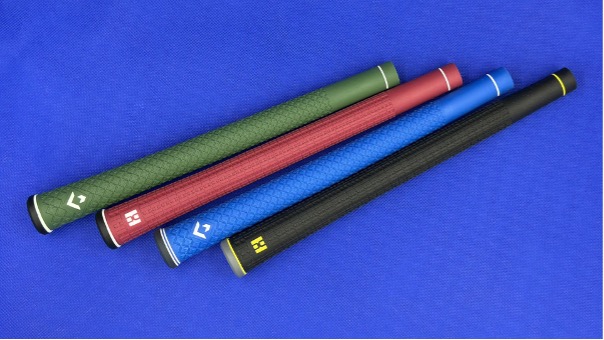
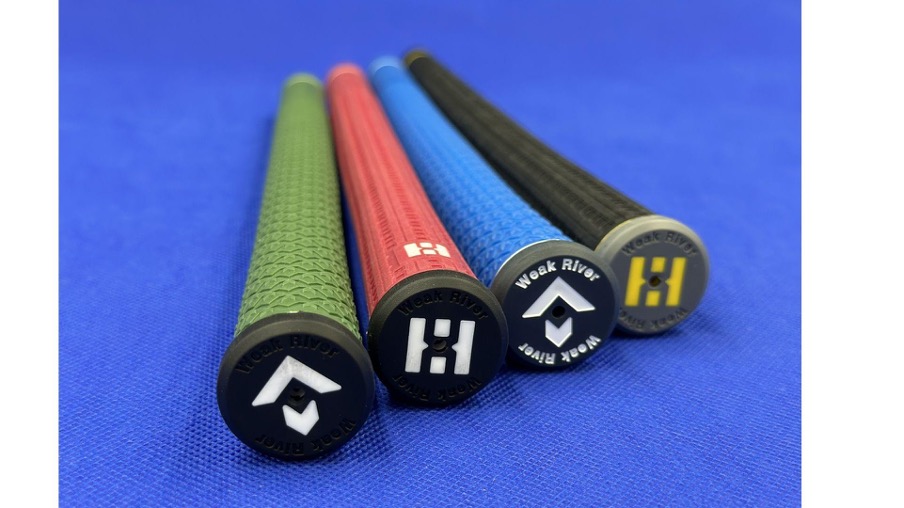
A typical development scenario: an OEM manufacturer targeting senior and recreational golfers needs a grip with lower Shore hardness for vibration absorption, dry-feel surface for control, and multi-color construction for SKU differentiation — all processable on existing injection molding tooling.
TSO series provides formulation-level control over each variable: hardness adjusted to spec, vibration damping tuned to the target feel profile, surface texture defined by compound formulation (no secondary finishing step), and multi-color overmolding executed in a single production cycle.
The alternative — sourcing a standard rubber compound and attempting to achieve these properties through post-processing or tooling changes — adds process complexity at each variable. Hardness variation in rubber requires compound reformulation. Vibration damping in rubber is not a design input. Surface texture in rubber depends on tooling surface, not compound chemistry.
EVERLON's application engineering team works directly with OEM customers to define compound specifications matched to specific product briefs.The underlying specification logic — choosing a compound that gives you formulation-level control over each performance variable — applies across grip categories, player segments, and production scales.
Material Selection Summary
Specify EVERLON TSO series TPE when:
-
Product brief defines hardness, vibration damping, or surface texture as measurable performance targets
-
Multi-color, multi-layer, or co-injection design is required
-
Production uses injection molding
-
Product is specified for outdoor use and weathering lifespan is a requirement
-
REACH and RoHS documentation is required for target market access
-
Recyclability is a product positioning or procurement criterion
Consider cord substrate supplementation when:
-
Maximum wet-weather surface friction is the overriding design objective and compound surface texture alone cannot meet the performance requirement
Specific questions about TSO hardness grades, test certifications, processing parameters, and compound customization scope are addressed below.
Frequently Asked Questions
-
What materials are golf grips made of?
Golf grips are manufactured from natural rubber, synthetic rubber, leather, or thermoplastic elastomers (TPE). In modern injection-molded OEM production, SEBS-based TPE has become the specification standard for premium-tier grip development, replacing rubber in applications where hardness customization, weathering resistance, and production efficiency are design requirements.
-
Is TPE better than rubber for golf grips?
SEBS-based TPE outperforms conventional rubber in UV resistance, hardness customization range, vibration damping tunability, multi-color design support, and injection molding processability. Rubber retains a raw material cost advantage in commodity-grade production and is preferred where high surface tack — rather than a dry-feel profile — is a specific design requirement.
-
Can TPE golf grips be injection molded?
Yes. TPE processes directly on standard injection molding equipment without vulcanization. Eliminating the cure stage reduces cycle time, simplifies tooling requirements, and enables tighter batch-to-batch dimensional consistency compared to rubber molding.
-
What Shore hardness should a golf grip be?
Golf grip hardness is a design parameter, not a fixed specification. Tour-level players typically prefer firmer profiles for responsiveness; recreational and joint-sensitive players favor softer compounds with higher vibration absorption. EVERLON's TSO series standard grade is Shore A 45–55, covering the majority of OEM golf grip specifications. Custom formulations are available on request for applications outside this range.
-
Are SEBS-based TPE golf grips suitable for long-term outdoor use?
Yes. SEBS-based TPE's saturated polymer backbone delivers strong UV stability, maintaining surface integrity and Shore hardness under sustained outdoor exposure. SBS-based rubber compounds — without the saturated backbone — are prone to yellowing, surface hardening, and cracking under UV cycling, shortening product lifespan.
-
Does EVERLON offer custom compound development for golf grip OEM programs?
Yes. EVERLON's application engineering team formulates TSO series compounds to specific OEM performance targets — hardness profile, vibration damping level, surface texture, overmolding compatibility, and color specification. Support covers the full development cycle from initial formulation through production qualification.
Ready to Define Your Golf Grip Material Specification?
Whether you are building a new grip line, evaluating a material upgrade from rubber to TPE, or qualifying compounds for injection molding production, EVERLON's application engineering team is ready to support your program.
Contact EVERLON — Start Your Custom Compound Development Today
Read More: