


Back

Share

TPE vs Silicone for Medical, Food and Sealing Parts


- ChatGPT
- Perplexity
- Google AI
- 2026-11-06


Choose silicone when a part has to survive repeated high-temperature steam sterilization or continuous service above about 150°C (300°F); for single-use medical components, soft-touch overmolds and high-volume seals, a thermoplastic elastomer (TPE) is usually the more efficient specification. Getting this call wrong costs money in both directions. An under-specified TPE seal can lose its recovery after repeated autoclave cycles, while an over-specified silicone part carries curing time, dedicated tooling and a qualification bill the application never needed. Before you request samples, write down three facts about the part: how it is sterilized and how often, the highest temperature it sees in service, and whether it has to hold a seal under constant compression.
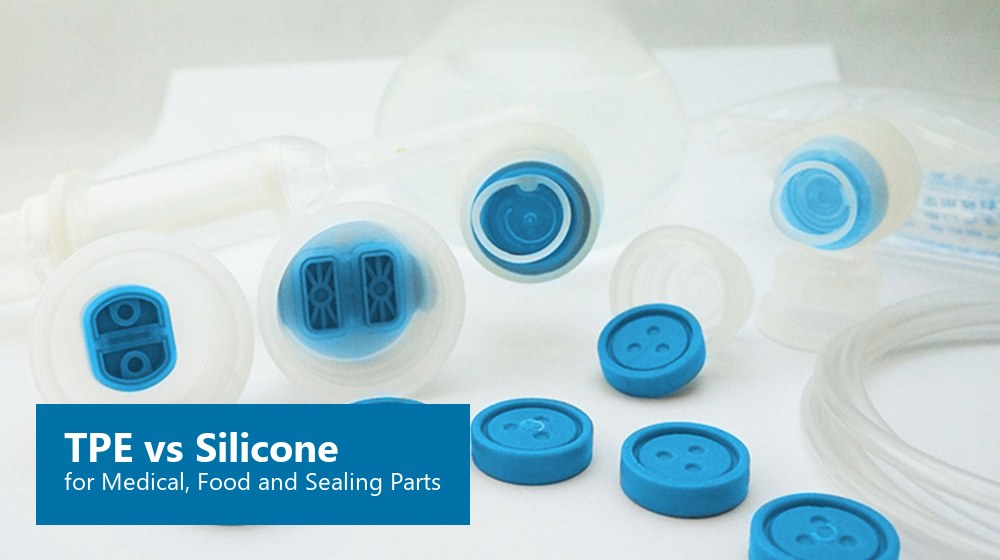
TPE vs Silicone at a Glance
TPE and silicone overlap on softness and feel, but they separate on heat resistance, sterilization, sealing at temperature, processing and regulatory route. The table below shows where each material usually lands. Grade-level data always overrides these general patterns.
| Property | TPE | Silicone |
|---|---|---|
| Polymer type | Thermoplastic: softens when heated and can be remelted | Thermoset: crosslinks during curing and never melts |
| Molding process | Standard injection molding or extrusion, with no cure step | Liquid injection molding of liquid silicone rubber (LSR) or compression molding of high-consistency rubber (HCR), with a cure step and sometimes a post-cure |
| Upper service temperature | Grade-dependent; above about 150°C (300°F), specialty rubbers such as silicone are the safer choice | Stays elastic well beyond the point where TPE softens |
| Steam sterilization | Single-use parts: grade-dependent. Our TM Series has passed customer testing at 121°C for 30 minutes | Suited to reusable parts that are autoclaved repeatedly |
| Compression set at elevated temperature | Rises as temperature approaches the grade's limit | Generally lower, meaning better recovery |
| Overmolding | Bonds in one shot to polypropylene (PP), polycarbonate (PC), acrylonitrile butadiene styrene (ABS) and polyethylene (PE) with the right grade | Needs self-bonding LSR grades or a primer |
| Production scrap | Sprues and runners can be reground where the application allows it | Cured scrap cannot be remelted |
| European Union (EU) food contact | Within Regulation (EU) No 10/2011 on plastics | Excluded from 10/2011; covered by framework and national rules |
| Main cost drivers | Compound price and cycle time | Material price, curing time and tooling |
Most of those rows trace back to a single difference in how the two polymers hold their shape.
The Core Difference: Thermoplastic vs Thermoset
TPE is a thermoplastic that softens when heated and can be remolded, while silicone is a thermoset that crosslinks permanently during curing. Most TPE compounds for medical and food applications are based on styrene-ethylene-butylene-styrene (SEBS) block copolymers. In SEBS, rigid styrene domains act as physical crosslinks at room temperature and release when the compound is heated, which is why TPE runs on standard thermoplastic equipment without a curing step. The same mechanism sets its heat ceiling.
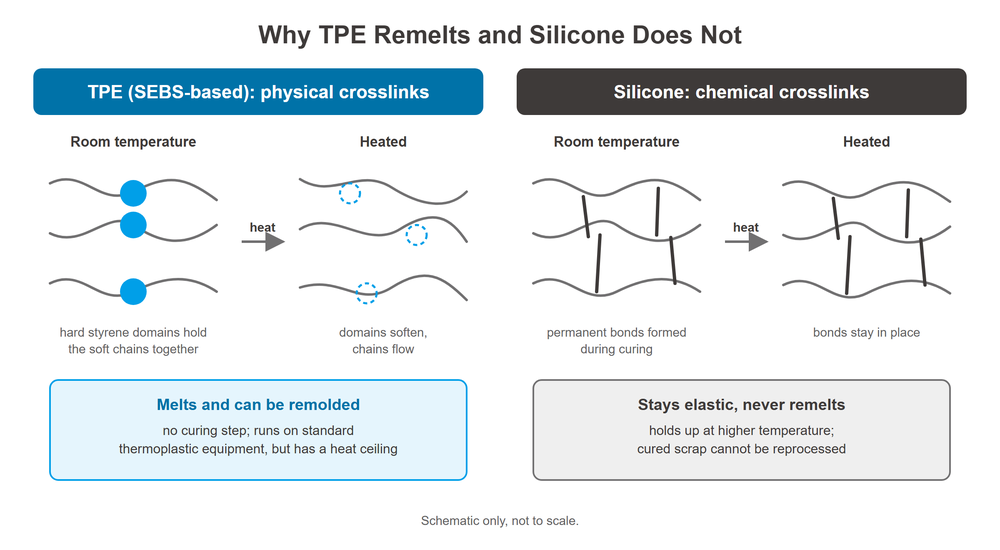
Silicone's silicon-oxygen backbone and chemical crosslinks keep it elastic at temperatures where TPE has started to soften. Our TPE vs TPR comparison covers the wider TPE family, including thermoplastic vulcanizates (TPV).
In medical work, that heat ceiling shows up first in one decision: how the part will be sterilized.
Sterilization: How TPE and Silicone Handle Steam, EtO and Gamma
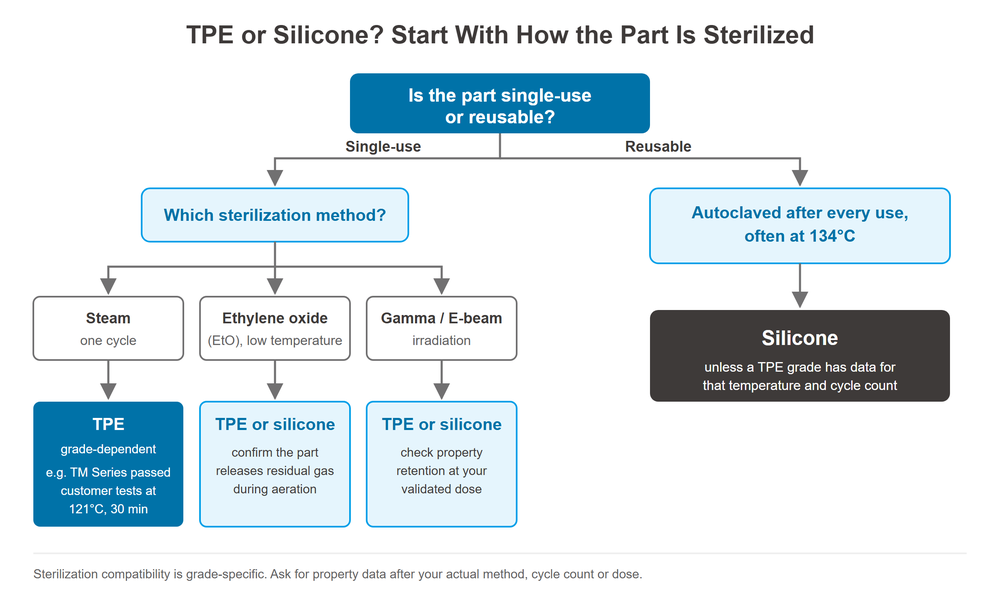
The dividing line in sterilization is single use versus reuse: TPE grades are built for the single cycle a disposable device sees, while silicone remains the safer choice for reusable parts that return to the autoclave after every use.
Steam sterilization (autoclave)
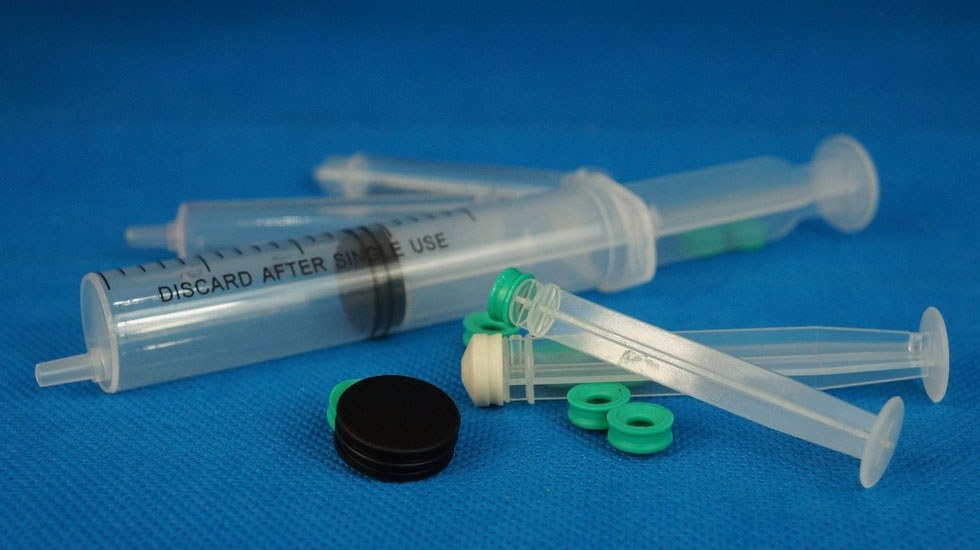
Steam is the most demanding sterilization method for TPE because it combines heat, moisture and time under pressure. Customers have steam-sterilized our TM Series medical compounds under the international standard condition of 121°C for 30 minutes, and the material passed. Our EVERMedi TPV syringe plunger seals are compatible with steam sterilization as well.
Reusable instruments are often reprocessed at 134°C after every use. Unless a TPE grade has data for that temperature and cycle count, those parts stay silicone territory, and we do not currently offer a grade validated for steam sterilization at 134°C.
Ethylene oxide (EtO)
Ethylene oxide (EtO) sterilizes at low temperature, so it is the most forgiving method for both materials. The practical requirement is that the part releases residual gas during aeration. Our EVERMedi TPV seals are compatible with EtO sterilization.
Gamma and electron-beam irradiation
Gamma and electron-beam (E-beam) irradiation can yellow, harden or embrittle elastomers, and the effect depends on dose and formulation more than on the material family. Our TM Series has not yet been validated for gamma sterilization. If your part will be sterilized by gamma or E-beam, test property retention at your planned dose before you lock the specification.
If your part sees more than one steam cycle or a specific irradiation dose, send us the cycle count, temperature or dose, because grade selection depends on it. Sterilizable packaging films are a separate topic, covered in our article on TPE compounds for medical device packaging.
Sterilization decides whether a part survives processing. Sealing performance decides whether it keeps working afterward.
Compression Set: When Silicone Seals Better Than TPE
Silicone generally holds a seal better than TPE under long-term compression at elevated temperature, while TPE is often sufficient for seals and stoppers that work at room or body temperature.
Compression set is the share of deformation a rubber sample keeps after it is squeezed for a set time at a set temperature and then released. ASTM D395, the compression set method published by ASTM International, is the common test, and a lower percentage means better recovery.
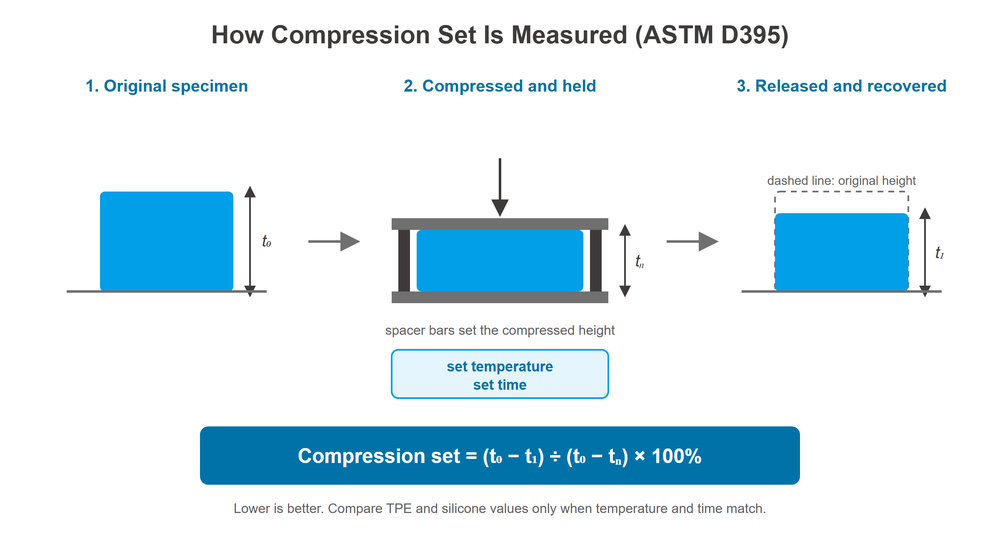
Datasheet values are comparable only when their test conditions match. A result measured at room temperature and the same result measured at 150°C describe very different materials, so check the temperature, duration and test method behind every figure before you compare a TPE with a silicone.
Our TM-45GWX compound, used in intravenous (IV) bottle closures, records 26% compression set under ASTM D395 after 22 hours at 70°C. You can see how TM-45GWX performs in its application in our article on TPE compounds for medical stoppers and Euro caps.
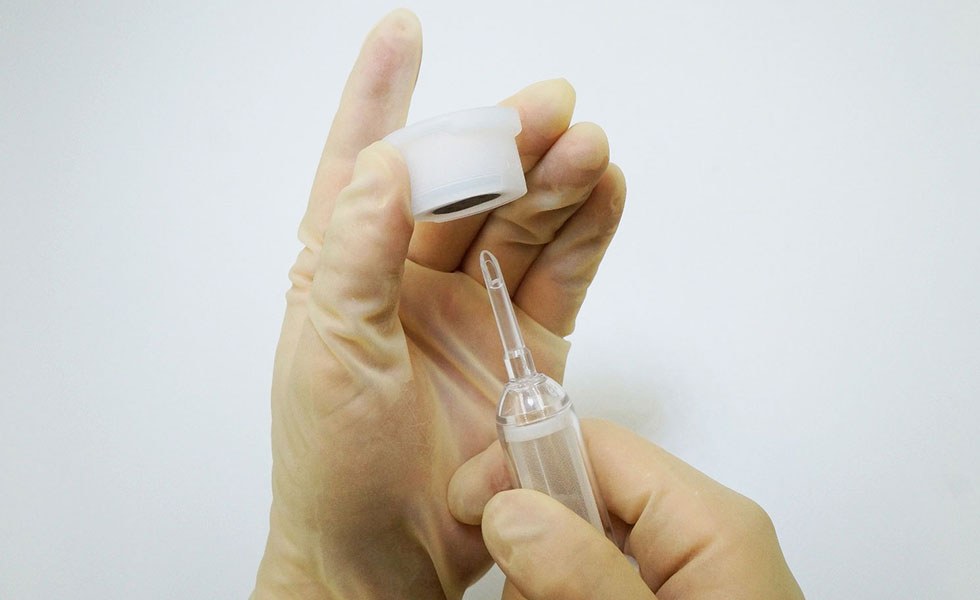
When you request samples, ask for compression set data at your actual service temperature, not the datasheet default. Once the part's physical performance is settled, the next filter is paperwork.
Food-Contact and Medical Compliance for TPE and Silicone
TPE and silicone reach food-contact and medical acceptance through different regulatory routes, so the documents you need from a supplier depend on the material.
Food contact in the EU and the United States
In the EU, Regulation (EU) No 10/2011 on plastic food-contact materials excludes silicones in Article 2. Silicone parts are assessed under the framework Regulation (EC) No 1935/2004 and national rules, such as the German Federal Institute for Risk Assessment (BfR) Recommendation XV on silicones. Non-vulcanized TPEs, including SEBS-based compounds, are treated as plastics and fall within 10/2011, which means migration testing against that regulation.
In the United States, silicone rubber for repeated-use food contact is commonly tested against 21 Code of Federal Regulations (CFR) 177.2600, which sets extractive limits for rubber articles intended for repeated use. For a TPE compound, ask the supplier which Food and Drug Administration (FDA) regulations each ingredient relies on rather than accepting a general "FDA compliant" statement. Our food-contact grades are described on the EVERSeal and EVERPeel food packaging page.
Medical biocompatibility: USP Class VI and ISO 10993
Biocompatibility belongs to a specific formulation, not to a material family, so a medical-grade silicone and a medical-grade TPE each need test data on the exact grade you mold.
United States Pharmacopeia (USP) Class VI remains a widely used material requirement in medical device and drug-packaging supply chains, and many customer specifications and existing validation files are built around it. A USP Class VI test report on a specific formulation is still meaningful evidence of that formulation's biological safety.
USP has also announced a revised chapter <88>, official December 1, 2026, that centers on the systemic injection test and no longer uses the Class I–VI designations. For a new project, confirm early whether your customer asks for a USP Class VI report or an evaluation under the ISO 10993 series from the International Organization for Standardization (ISO), such as ISO 10993-5 for cytotoxicity and ISO 10993-10 for sensitization. Drug-packaging elastomers such as stoppers and plungers continue to be evaluated under USP's packaging chapters, including <87> in vitro testing.
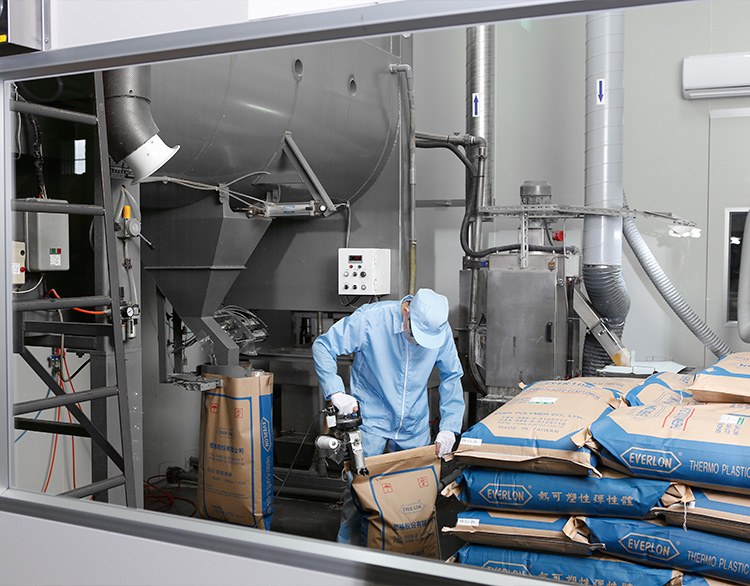
Our EVERMedi medical compounds are produced on a Class 100,000 cleanroom line. Whichever material you choose, ask for the test reports on the specific grade, with the report date and testing laboratory.
Compliance and performance settle whether a material can be used. Processing settles what it costs.
Molding, Cycle Time and Scrap: TPE vs Silicone Processing
TPE usually costs less to process than silicone because it molds on standard thermoplastic equipment with no curing step, although the scrap advantage is smaller than often claimed in regulated parts.
The processing differences come down to three points:
-
No cure step. TPE solidifies as it cools in the mold. Silicone cures in a heated mold, and some grades need a post-cure before they reach final properties.
-
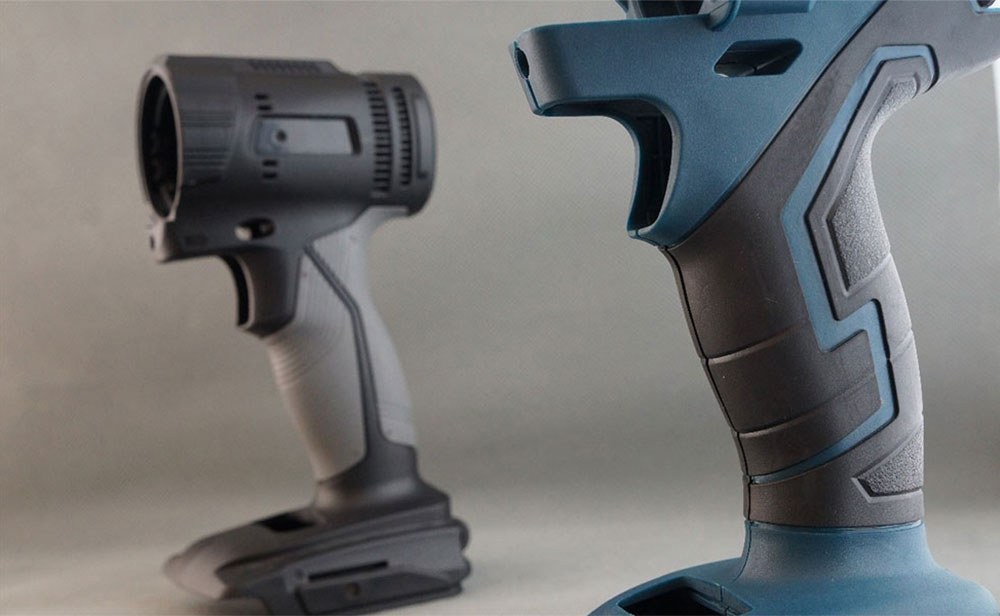
One-shot overmolding. Overmolding TPE grades bond to PP, PC and ABS in two-shot or insert molding, as covered on our TA Series overmolding page. Silicone needs a self-bonding LSR grade or a primer to adhere to most plastics.
-
Reusable scrap. TPE sprues, runners and rejects can be reground. Cured silicone scrap cannot be remelted.
Regrind is the point that needs a caveat. Food-contact and biocompatibility data apply to the virgin grade, so using regrind in a regulated part requires its own validation, and many medical device makers do not allow it. For medical and food-contact applications, our recommendation is to use regrind only in parts that do not contact the body or food. Against LSR molded with cold-runner systems, which waste little material in the first place, the scrap gap narrows further.
Cost and cycle time make TPE attractive, but they do not override the conditions that rule it out.
When Silicone Is the Right Choice
Silicone is the right specification when heat, repeated sterilization or long-term compression at temperature exceed what a TPE grade can document. Four situations call for it:
-
Reusable devices that go through high-temperature autoclave cycles after every use.
-
Continuous service above about 150°C (300°F), where TPE is close to or past its softening range.
-
Seals under long-term compression at elevated temperature, where silicone's lower compression set protects the seal over the part's life.
-
Parts already validated in silicone, where requalification would cost more than the material savings.
Outside those four situations, the case for TPE gets stronger.
When TPE Is the Better Choice: Medical, Food and Sealing Applications
TPE is usually the better choice for single-use medical components, soft-touch overmolds, and high-volume seals and food-contact parts that operate below its heat ceiling. Each of those applications maps to one of our compound series:
-
Single-use medical parts such as stoppers, plunger seals, tubing and breathing masks: our TM Series, available from 30 to 90 Shore A and 30 to 65 Shore D in transparent and translucent grades, and EVERMedi TPV for plunger seals. Our article on TPE compounds in medical tubing and IV sets shows one of these applications in detail.
-
Medical packaging components: our TM Series or TP Series. The TP Series is compatible with common container materials such as PP, PE, polystyrene (PS) and polyethylene terephthalate (PET).
-
Soft-touch overmolding on PP, PC and ABS housings: our TA Series.
-
Food packaging seals and liners: our EVERSeal grades.
-
Parts that need a silicone-like feel: our TSIV Series, whose surface texture and feel are closer to silicone.
Grade selection within each series depends on your sterilization and sealing conditions, which is why the switch itself needs a test plan.
Switching From Silicone to TPE: What to Test First
Switching a validated part from silicone to TPE is a requalification project, so test the conditions that silicone was originally chosen for before you compare prices. Run these seven checks on the candidate TPE grade:
| # | Test | Why it matters |
|---|---|---|
| 1 | Sterilization at your actual method and cycle count | A grade rated for one cycle may not survive ten |
| 2 | Compression set at your service temperature | Datasheet values are often measured at a different temperature |
| 3 | Extractables and leachables | The formulation changes, so the extractables profile changes |
| 4 | Biocompatibility or food-contact testing | Existing silicone reports do not transfer to a new material |
| 5 | Bond strength to your substrate | Overmolding only works with a grade matched to the substrate |
| 6 | Regrind policy | Decide before production whether regrind is allowed in the part |
| 7 | Tooling: venting and shrinkage | A silicone mold is vented and sized for a different material |
Those seven checks also explain the questions that come up most often when buyers compare the two materials.
TPE vs Silicone FAQ
The four questions below appear alongside TPE vs silicone searches on Google.
Q1:Is TPE material better than silicone?
Neither TPE nor silicone is better across the board. TPE is better for single-use medical parts, overmolding onto plastics and high-volume molding with reusable production scrap. Silicone is better for repeated high-temperature sterilization, continuous service above about 150°C (300°F) and long-term sealing at elevated temperature.
Q2:What are the disadvantages of TPE?
TPE's main limits are heat and compression at temperature. It softens as it approaches its thermoplastic limit, it has less margin than silicone for repeated autoclave cycles, and its compression set rises at elevated temperature. Medical, food-contact and overmolding grades differ widely, so judge the specific grade.
Q3:Is TPE the same as silicone?
TPE is not the same as silicone. TPE is a thermoplastic elastomer that melts and can be remolded, while silicone is a thermoset elastomer with a silicon-oxygen backbone that cures permanently. The two can feel similar, but they differ in heat resistance, processing, recyclability and food-contact regulation.
Q4:What is TPE and is it safe?
TPE is a family of rubber-like thermoplastics; SEBS-based compounds are the most common type for medical and food use. Safety is grade-specific. A medical or food-contact TPE needs biocompatibility or migration data on that exact formulation, under ISO 10993 for devices or Regulation (EU) No 10/2011 and FDA rules for food contact.
Get a TPE Grade Recommendation for Your Part
A comparison like this one cannot tell you whether a specific TPE grade will hold up in your part. That answer depends on details only you have: the sterilization method and cycle count, the highest service temperature, how long the part stays compressed, and the plastic it bonds to.
Send those details through our contact form. Fill in the hardness, bonding substrate and required standards fields, then add the sterilization method, service temperature and current silicone hardness in the comments box. Our application engineers will reply with a recommended grade and the tests to run first. If you already use our compounds, contact your existing sales representative directly.